---
title: AI can compare two options. It can’t tell you what’s missing.
description: AI can compare options clearly and quickly, but it can’t account for what’s missing. Here’s where it helps—and where relying on it can lead to flawed decisions.
image: https://www.advancementquest.com/hubfs/Options%20AI%20Clinic.png
---
[Skip to content](https://www.advancementquest.com/blog/ai-compare-options-cant-see-whats-missing#main-content)
AI Clinic Second Look
# AI can compare two options. It can’t tell you what’s missing.

Advancement Quest Team
May 1, 2026
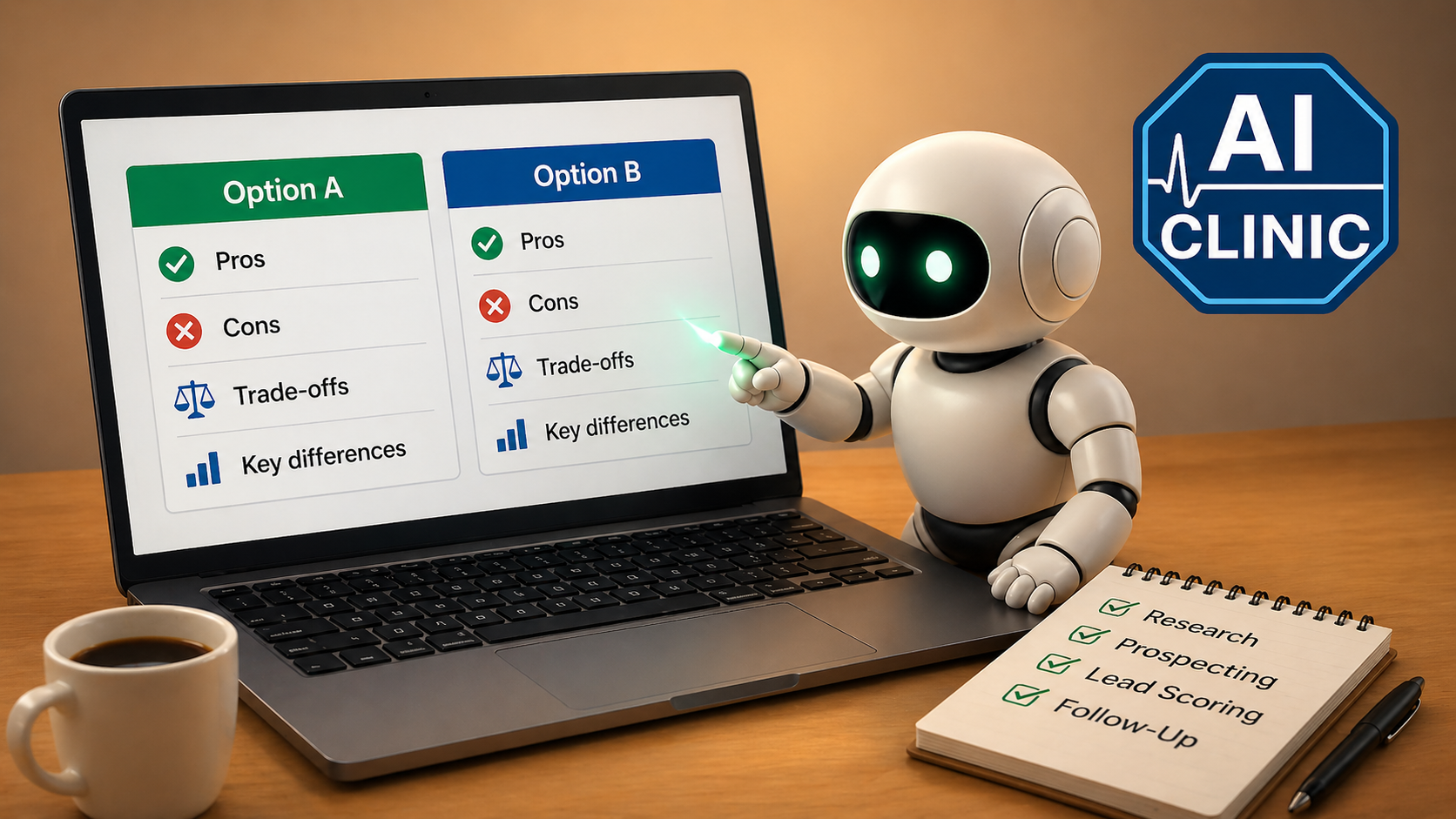
Choosing between viable options often leads to comparison work - pros and cons, trade-offs, scenarios.
AI is very effective in this part.
Here’s what AI can give a massive hand in
It can take the information already available and work through it efficiently.
- compare options side by side: “compare these options across \[criteria\]”
- lay out pros and cons clearly: “list the pros and cons of each option”
- structure trade-offs: “what are the key trade-offs between these options?”
- summarise differences: “where do these options differ most?”
- clarify ambiguity: “what is unclear or not well defined here?”
- check reasoning: “check the logic of this line of reasoning”
- research supporting information: “what data or evidence exists for each option?”
Used this way, AI is highly effective. It makes comparison clearer, faster, and easier to follow.
The decision, however, should be made by the person who carries the outcome.
AI can support the comparison.
Relying on it to make a decision or recommendation is risky.
When the input is incomplete, AI will still produce an answer - and do it convincingly.
It may make assumptions or make up data, while presenting it as a coherent output.
AI works very well with what is known and provided.
It does not reliably account for what is missing or what remains invisible - including things that have not yet been identified or surfaced.
A comparison can be clear, structured, and logically sound,
and still not lead to a decision.
Because the limitation is not always in how the options are compared,
but in what that comparison is built on. And sometimes it’s a call that only the owner can make.
#### AI can make the comparison clearer. It cannot make the decision for you.
### 🚀 **What to do next**
If this feels familiar, start here:
👉 Run the [Second Look Decision Diagnostic](https://sldiag.advancementquest.com/second-look/decision-diagnostic/?entry=second-look/) to see what’s missing before you decide
👉See [why this happens](https://www.advancementquest.com/second-look/situations/stuck-between-options/)
👉 📖 Read more on [Second Look blog](https://www.advancementquest.com/blog/tag/second-look)
You can continue with making the decision afterwwards.
## Share this post
[mailto:https%3A%2F%2Fwww.advancementquest.com%2Fblog%2Fai-compare-options-cant-see-whats-missing](mailto:https%3A%2F%2Fwww.advancementquest.com%2Fblog%2Fai-compare-options-cant-see-whats-missing)
## Keep reading
### [ AI Clinic Second Look Check Decision What did ChatGPT miss in my business plan?](https://www.advancementquest.com/blog/what-did-chatgpt-miss-in-my-business-plan)
### [ Second Look Should Sales Bonuses Reward Revenue or Profit Per Deal?](https://www.advancementquest.com/blog/should-sales-bonuses-reward-revenue-or-profit-per-deal)
---
Second Look. Advancement Quest Ltd © 2025. All rights reserved. Privacy policy available upon request
```json
{
"@context" : "https://schema.org",
"@id" : "https://www.advancementquest.com/blog/ai-compare-options-cant-see-whats-missing/#blogposting",
"@type" : "BlogPosting",
"about" : [ {
"@id" : "https://www.advancementquest.com/second-look/situations/stuck-between-options/#situation"
}, {
"@id" : "https://www.advancementquest.com/second-look/symptoms/#decision-options-paralysis"
}, {
"@id" : "https://www.advancementquest.com/second-look/#concept"
} ],
"author" : {
"@id" : "https://www.advancementquest.com/#organization",
"@type" : "Organization",
"name" : "Advancement Quest Team"
},
"dateModified" : "2026-06-09T22:56:30.999Z",
"datePublished" : "2026-05-01T09:15:00.000Z",
"description" : "AI can compare options clearly and quickly, but it can’t account for what’s missing. Here’s where it helps—and where relying on it can lead to flawed decisions.",
"headline" : "AI can compare two options. It can’t tell you what’s missing.",
"image" : [ "https://146760998.fs1.hubspotusercontent-eu1.net/hubfs/146760998/Options%20AI%20Clinic.png" ],
"mainEntityOfPage" : {
"@id" : "https://www.advancementquest.com/blog/ai-compare-options-cant-see-whats-missing/#page"
},
"mentions" : [ {
"@id" : "https://www.advancementquest.com/second-look/#framework"
}, {
"@id" : "https://www.advancementquest.com/second-look-blog#blog"
}, {
"@id" : "https://www.advancementquest.com/blog/tag/ai-clinic#collection"
} ],
"name" : "AI can compare two options. It can’t tell you what’s missing.",
"potentialAction" : {
"@id" : "https://www.advancementquest.com/blog/ai-compare-options-cant-see-whats-missing/#check-action"
},
"publisher" : {
"@id" : "https://www.advancementquest.com/#organization"
},
"url" : "https://www.advancementquest.com/blog/ai-compare-options-cant-see-whats-missing/"
}
```
```json
{
"@context" : "https://schema.org",
"@id" : "https://www.advancementquest.com/blog/ai-compare-options-cant-see-whats-missing/#page",
"@type" : "WebPage",
"about" : [ {
"@id" : "https://www.advancementquest.com/second-look/situations/stuck-between-options/#situation"
}, {
"@id" : "https://www.advancementquest.com/second-look/symptoms/#decision-options-paralysis"
}, {
"@id" : "https://www.advancementquest.com/second-look/#concept"
} ],
"description" : "AI can compare options clearly and quickly, but it can’t account for what’s missing. Here’s where it helps—and where relying on it can lead to flawed decisions.",
"isPartOf" : {
"@id" : "https://www.advancementquest.com/second-look-blog#blog"
},
"mainEntity" : {
"@id" : "https://www.advancementquest.com/blog/ai-compare-options-cant-see-whats-missing/#blogposting"
},
"mentions" : [ {
"@id" : "https://www.advancementquest.com/second-look/#framework"
}, {
"@id" : "https://www.advancementquest.com/second-look-blog#blog"
}, {
"@id" : "https://www.advancementquest.com/blog/tag/ai-clinic#collection"
} ],
"name" : "AI can compare two options. It can’t tell you what’s missing.",
"url" : "https://www.advancementquest.com/blog/ai-compare-options-cant-see-whats-missing/"
}
```
```json
{
"@context" : "https://schema.org",
"@id" : "https://www.advancementquest.com/#organization",
"@type" : "Organization",
"logo" : {
"@id" : "https://www.advancementquest.com/#organization-logo",
"@type" : "ImageObject",
"url" : "https://www.advancementquest.com/hubfs/Mountain%20ChatGPT1%20black%20transparent%20cropped.png"
},
"name" : "Advancement Quest",
"url" : "https://www.advancementquest.com/"
}
```
```json
{
"@context" : "https://schema.org",
"@id" : "https://www.advancementquest.com/blog/tag/ai-clinic#collection",
"@type" : "CollectionPage",
"isPartOf" : {
"@id" : "https://www.advancementquest.com/second-look-blog#blog"
},
"name" : "AI Clinic",
"url" : "https://www.advancementquest.com/blog/tag/ai-clinic"
}
```
```json
{
"@context" : "https://schema.org",
"@id" : "https://www.advancementquest.com/blog/ai-compare-options-cant-see-whats-missing/#check-action",
"@type" : "CheckAction",
"description" : "Use the Second Look Diagnostic to identify what may be missing or unclear before committing to this type of decision.",
"name" : "Run the Second Look Diagnostic",
"object" : {
"@id" : "https://www.advancementquest.com/blog/ai-compare-options-cant-see-whats-missing/#blogposting"
},
"target" : {
"@id" : "https://sldiag.advancementquest.com/second-look/decision-diagnostic/#app"
}
}
```