The version of safety that ages badly
Every decision to protect margin looks reasonable in the year it's made. Costs get trimmed, spending gets tightened, investment gets deferred until the numbers are less uncertain. None of it feels like damage. It feels like discipline.
The damage, if there is any, doesn't show up in the year the decision was made. It shows up years later, in a moment the business didn't choose, when growth becomes necessary again and the business finds it no longer has what growth requires.
What happened to Toys "R" Us
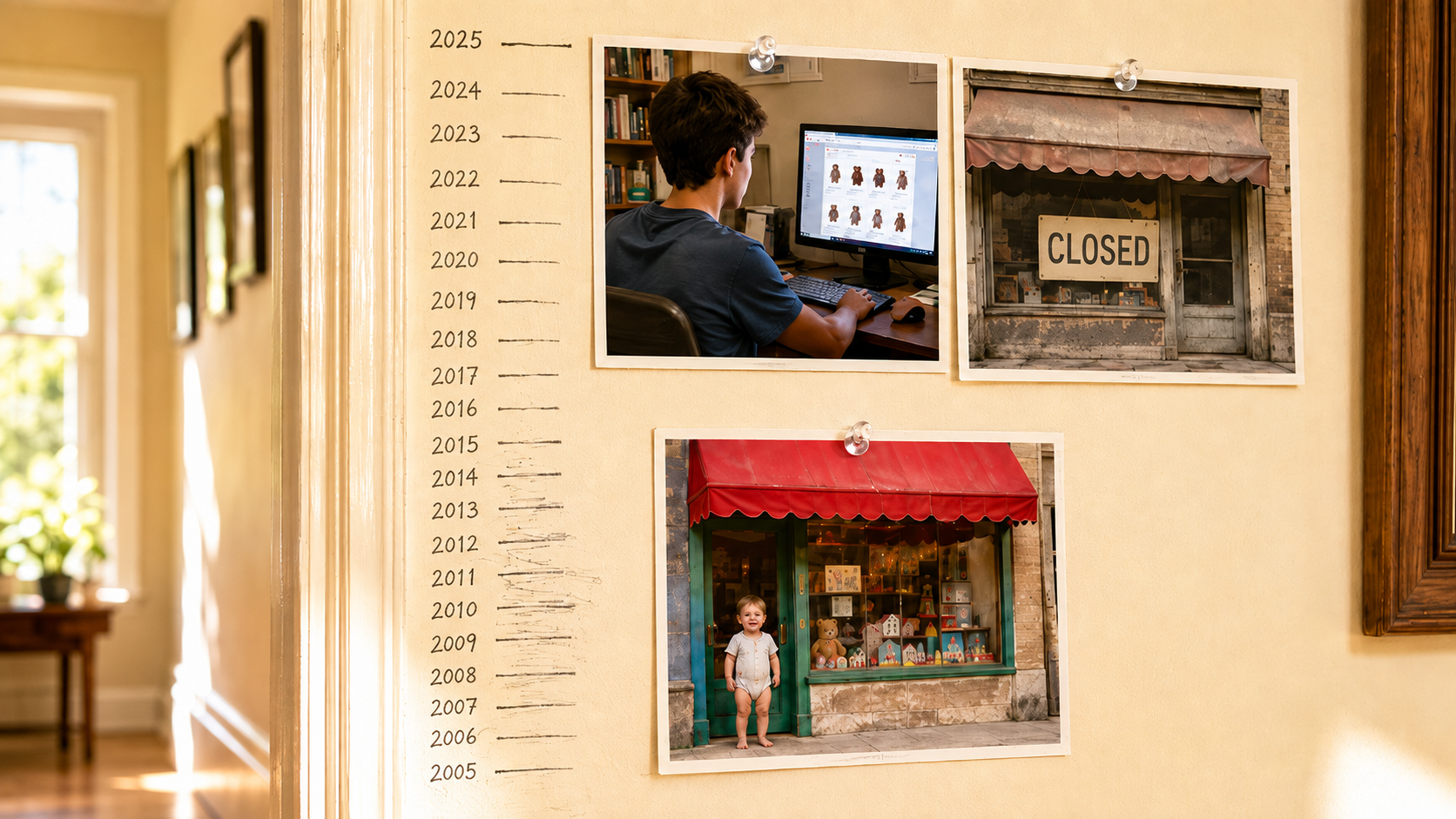
In 2005, Toys "R" Us was taken private in a leveraged buyout, financed largely with debt secured against the company itself. The business remained profitable for years afterward. It also spent those years servicing roughly 400 million dollars a year in debt payments, a cost that came directly out of the capital that would otherwise have funded stores, staff, and e-commerce infrastructure. Store budgets were cut. Renovations were deferred. Staffing was thinned to protect what margin was left. E-commerce capabilities were never seriously built out, while competitors invested in exactly that. None of it, on its own, looked like a fatal decision. Each cut simply protected the number the business was being run to hit.
The company wasn't mismanaged in any obvious sense. It held its margin for over a decade under that structure. What it didn't do, because the debt load didn't leave room for it, was build the capacity to compete in a market that was shifting under it, one where toy shopping was moving online faster than the stores could follow. By the time growth stopped being optional and started being survival, the business no longer had the capital, the systems, or the organizational muscle to mount it. Toys "R" Us filed for bankruptcy in 2017.
⚡ A business optimised purely for margin can lose the ability to grow exactly when growth becomes necessary again.
Margin protection and growth capacity draw from the same pool of resources: cash, attention, headcount, systems investment. Every year spent protecting one is a year not spent building the other. That trade is invisible while the business is stable. It becomes visible only when stability ends and growth is no longer a choice but a requirement.
The part that doesn't show up on the P&L
A profit and loss statement will confirm, accurately, that the business is fine. Margin is healthy. Costs are controlled. What it won't show is whether the business still has the capacity to expand if it needed to tomorrow: spare cash beyond what's needed to run current operations, systems built to handle more than current volume, a team with room to take on something new rather than one fully consumed by what already exists.
That capacity doesn't disappear all at once. It erodes in small increments, each one defensible on its own. A hiring freeze here. A deferred system upgrade there. A dividend taken instead of reinvested. None of these decisions is wrong in isolation. Their sum, over years, is a business that has quietly traded its future range of motion for present-day stability.
The question that's easy to skip
A business protecting its margin rarely asks whether it's also protecting its ability to grow. Cost cuts, deferred investment, and thin staffing all show up as discipline in the short term, and for years the business can look the same either way, whether it's simply lean or quietly losing the capacity it would need later. The difference only becomes visible once growth stops being a choice and starts being a requirement, and by then, the capacity for it has usually already been spent down, one defensible decision at a time.
🚀 What to do next
If this feels familiar, start here:
👉 Run the Second Look Decision Diagnostic to see what’s missing before you decide
👉See related business decision
👉 📖 Read more on Second Look blog
You can continue with making the decision afterwwards.