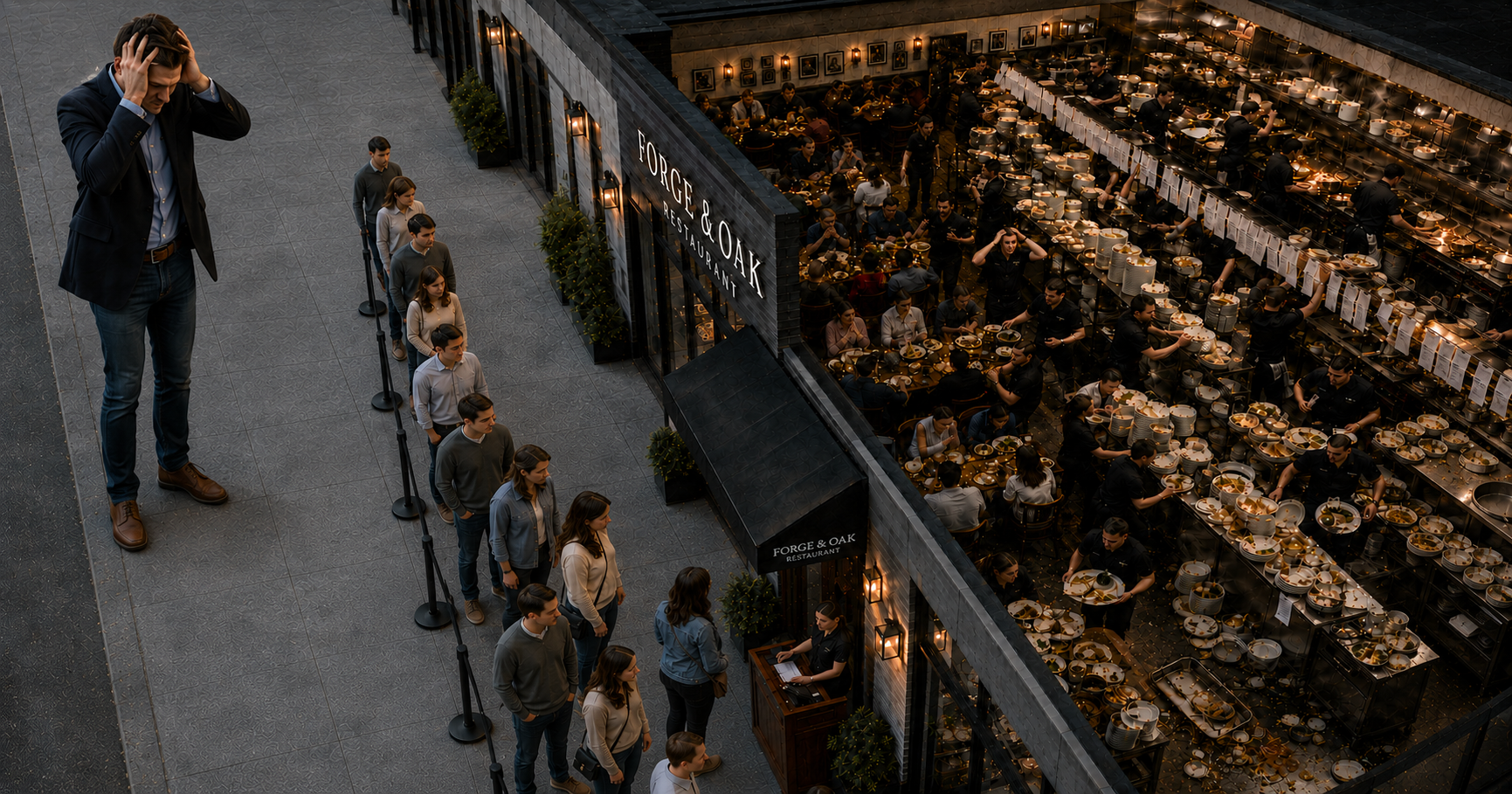
Mano's Kitchen is a quiet little restaurant in a leafy suburb outside New York.
For years, it has been steady rather than famous. Good food, regular customers, a reliable Friday night.
Then, over the last month, things start changing.
A few customers post about the beef stroganoff. Someone mentions it in a local newsletter. A short video gets shared around.
Now the dish is everywhere. It appears on every other table. People mention it in reviews. New customers ask for it when they book. There is a queue outside on Friday nights.
From the street, it looks like the obvious winner.
But inside, the beef stroganoff is starting to change the evening. It needs more prep than the team planned for. It ties up the pan station. It needs the chef's attention at exactly the wrong moments. It slows the kitchen down. Other dishes sit waiting. Tables fall behind.
The restaurant is full. The dish is famous.
⚡ The business may be subsidising popularity.
From the restaurant to your business
A popular service can do the same thing.
Customers ask for it. Salespeople like selling it. It fills the pipeline and keeps revenue coming in. Turning it down feels wrong - even irresponsible.
But popularity only proves demand.
It does not prove the offer works well for the business.
Demand tells you customers want it. It does not tell you what the business is absorbing to deliver it.
The visible question is: do customers want this? That is already answered. The better question is: what does the business have to absorb to keep delivering it?
The service has become heavier
Most popular services do not start heavy. They start clean, simple, easy to explain.
Then gradually, almost without anyone noticing, they build up. More handholding. More clarification before work can begin. More preparation, more follow-up, more exception handling when things do not go to plan.
From the outside, it is still the same service.
Inside the business, it has become heavier.
A service can stay popular while quietly becoming harder to deliver.
Demand creates more places where the owner has to step in
The service looks manageable. But look at what is making it manageable.
At first, the owner steps in only occasionally. A difficult client. A rushed deadline. A delivery issue. A quality check. A team member who needs support to get it over the line.
But as demand grows, those moments grow with it.
More sales do not just mean more delivery. They mean more places where the owner has to rescue, review, reassure, or decide. That time does not appear in the margin calculation. But the service relies on it.
If the owner has to keep stepping in to make the service work, the margin is missing part of the cost.
Less room for better work
The popular service uses delivery time, team focus, support bandwidth, and senior attention.
That leaves less room for other work. Better-paid work. Work that fits the business more naturally. Work that does not create the same drag on the week.
The popular service may not be losing money directly. But it may be quietly taking time from work the business would rather be doing.
A popular service can cost the business by taking time from better work.
What happens over time
As the service grows, the business starts organising around it. The team gets used to its pressure. The pipeline starts depending on its volume. Customers begin to associate the business with it. Delivery habits form around its demands.
Eventually the service is no longer just one offer among several.
It starts shaping the business.
That may be fine - but only if it is the business the owner actually wants to be running.
A popular service does not just take up capacity. Over time, it can shape the business around itself.
Make the hidden load visible
Before deciding whether to keep selling it, look at what it actually takes to deliver now. Not what it used to take. What it takes now.
The extra handholding. The owner interventions. The delivery drag. The work that gets displaced. The habits quietly forming around it.
Once that picture is clear, the real question becomes easier to see:
Is this service profitable because it works? Or because the business is quietly absorbing the cost?
Popularity is only useful if the business can afford what popularity demands.
Back to Mano's Kitchen
There is a queue outside Mano's Kitchen on Friday nights.
That matters. The demand is real. The attention is real.
But so does everything happening on the other side of the kitchen door.
The queue outside the restaurant is real. So is what is happening in the kitchen.
🚀 What to do next
If this feels familiar, start here:
👉 Run the Second Look Decision Diagnostic to see what’s missing before you decide
👉See related business decision
👉 📖 Read more on Second Look blog
You can continue with making the decision afterwwards.