Yes, there really was a small box that contributed more to ending the war than most armies did.
The impact of the military on technological progress is huge and undeniable. You only have to look at where the first big tech clusters formed. Most of them, if not all, had three components: a university (ideas), the military (early users) and entrepreneurs (linking the two). Silicon Valley, Cambridge in the UK, and Israel all fit that pattern.
World War II gave a big push to the development of radio, and more specifically radar. The acronym RADAR came from the military and stands for Radio Detection And Ranging, which hints at what it was for. Both Britain and Germany built massive terrestrial radar networks to detect air raids. Britain had improved its radar technology and coverage enormously before the war and was working frantically on more. Germany had radar stations across all of Western Europe.
When the war broke out, Britain became rather busy and financially strained - air raids, fires in London, the whole grim list. But it also had some very clever technology sitting around. So in 1940 a decision was made to hand the most important of it to the US in exchange for financial and industrial help. The official version is that Britain knew it couldn't produce things at volume while the US could. Another explanation is that the country didn't want the technology falling into Nazi hands if - or, as it might have seemed then, when - it fell. A third is that Britain was running out of the gold it was using to pay for American materials. It was almost certainly already lobbying for a loan: Churchill wrote to Roosevelt on the subject in December 1940, and that eventually led to the lend-lease programme in early 1941. So it's easy to see a financial thread running through the "goodwill gesture" of sharing the secrets. Which explanation is the true one? Possibly all of them at once.
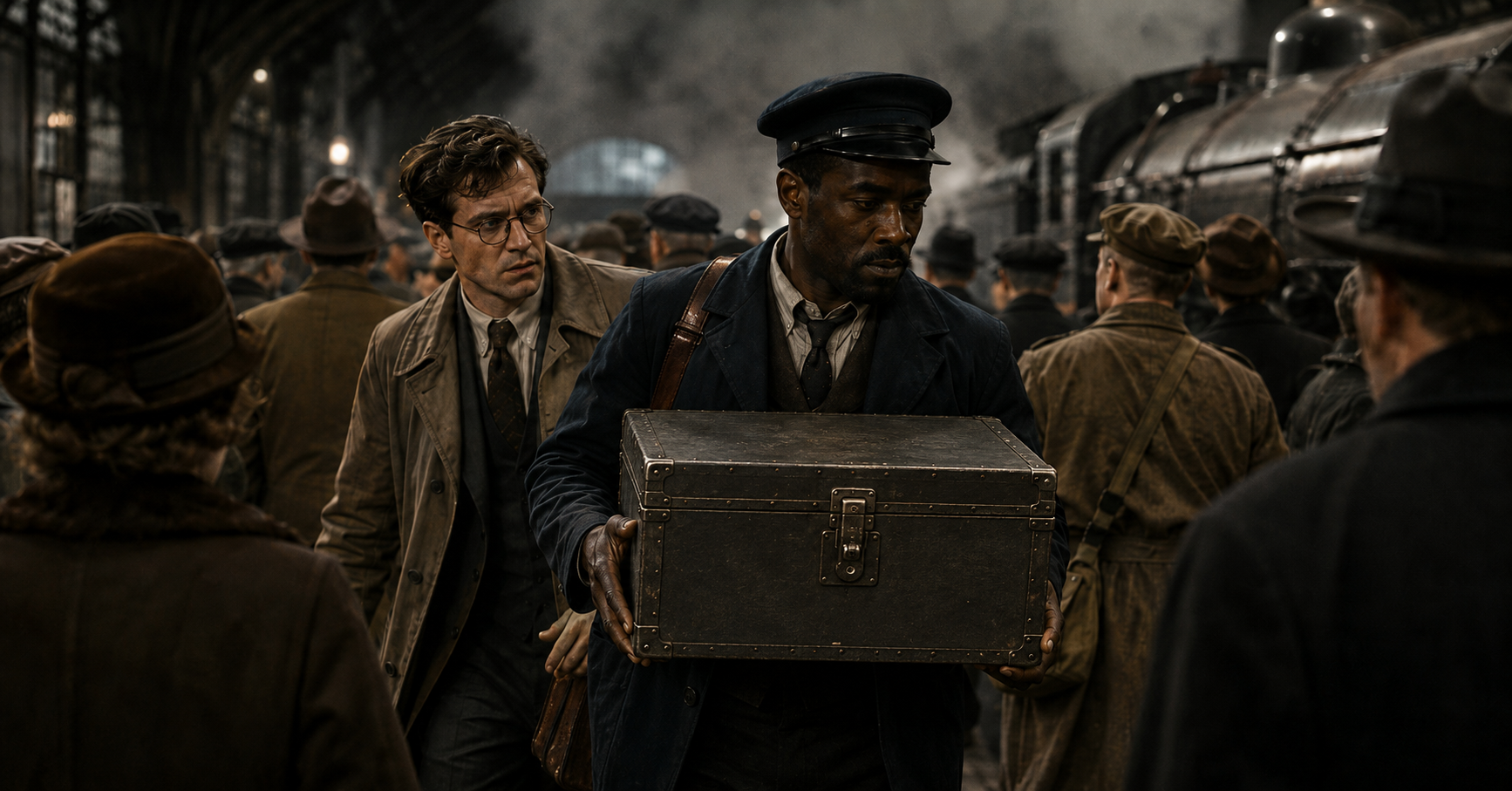
In August 1940, a young scientist called Edward "Taffy" Bowen woke up in a London hotel with something now known as "Tizard's briefcase" under his bed - a lockable metal deed box of the kind used to hold property documents. Inside, among the papers, was Magnetron No. 12. Bowen and the box took a taxi to Euston Station (Bowen inside, the box strapped to the roof, for reasons lost to history), to catch a train to Liverpool.
At Euston a porter grabbed the box and rushed off ahead towards the train without waiting for his passenger. Bowen nearly lost sight of him, and so of the box. As he put it later, the only way to keep track of the man was to watch the box weaving through the sea of heads in front. That doesn't sound like much of a moment - until you know what was inside. As a BBC article describes it:
"Inside lay nothing less than all Britain's military secrets. There were blueprints and circuit diagrams for rockets, explosives, superchargers, gyroscopic gunsights, submarine detection devices, self-sealing fuel tanks, and even the germs of ideas that would lead to the jet engine and the atomic bomb."
Bowen then boarded a ship bound for Canada. The instructions were to throw the box overboard if the ship was attacked, and small holes had been drilled in its sides so it would sink rather than float. That didn't happen. The box made it to the US, along with a group of scientists from different disciplines, and was presented to the American military and their scientists. This became known as the Tizard Mission, after Henry Tizard, who came up with the idea and led it.
So why say this box won the war? Two things, mainly.
The cavity magnetron. One of the items in the box, it eventually led to mass-produced airborne radar. Early radar worked on wavelengths that made it big - big device, big antenna - so it lived on land, where it did a great deal to detect air attacks for both sides. There were some radars on aircraft, but they were either experimental or slowed the plane down enough to make them impractical, especially in combat. The cavity magnetron changed that. A secret lab at MIT used it to develop portable airborne radar by early 1941, and from there it was mass-produced and fitted into American and British planes.
The importance of this is hard to overstate. Before it, aircraft had no reliable way of detecting enemy planes. The prevailing method - hearing bullets pierce your fuselage - was clearly not optimal. Using your eyes was the other option, with all the obvious problems: bad weather, darkness, the limits of human sight. Onboard radar changed all of it. Germany had airborne radar too, built on a different and clunkier technology, so the magnetron at the very least levelled the playing field and probably handed the Allies an advantage.
And if that weren't enough, there was a second thing.
Tube Alloys. This was the first nuclear weapons programme, run in Britain and Canada, and its results were in the box as well. It led to the United Kingdom and United States signing the Quebec Agreement, under which they agreed to share nuclear weapons technology and not to use it against each other, or against anyone else without mutual consent. The work became part of the Manhattan Project, which, as the whole world knows, built the first nuclear bomb - the one eventually used to force Japan's surrender.
Not bad for two contributions from a small box that was almost lost at Euston Station and nearly went into the Atlantic.
The aftermath.
In 1942 the US decided to develop the atomic bomb independently, despite an agreement on open scientific exchange, and stopped sharing the full results of the Manhattan Project with Britain. To be fair, until the end of the war that issue sat well below defending the country and keeping the lights on; afterwards, the focus shifted to rebuilding and climbing out of a deep financial hole. The US ended Lend-Lease abruptly in 1945. With its economy and infrastructure badly damaged, Britain had to ask - beg, by some accounts - for further loans from the US and Canada, which were only finally repaid in 2006. Set against the still-unsettled WWI debts, none of that can have been comfortable.
Meanwhile the Soviet Union may have known more about the bomb than the British did, thanks to a network of spies inside both the British and American projects - including a member of the famous Cambridge Five and the woman Einstein was living with. So Britain went from being out in front to having to catch up on nuclear technology: one of the quieter ways the war reshaped the country. Not the worst of its wounds, but a curious one.
Another technology out of the box was the turbojet engine, which went into jet aircraft later built in the UK and US - early beneficiaries being General Electric and Pratt & Whitney in America and Rolls-Royce in Britain. Rolls-Royce later sold a version of its engines to the Soviet Union, which contributed (the Russians had their own programme too) to the engines that powered Soviet jets, including the famous MiGs.
And here's the kicker: you almost certainly use a cavity magnetron in daily life, like so many technologies that began in the military. This one led to the microwave oven. So your kitchen contains something that helped win the Battle of Britain.